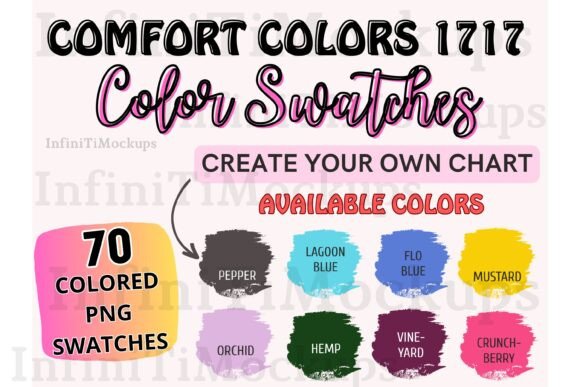
Stop Guessing Your Shirt Colors: The Comfort Colors 1717 Guide
If you run a print-on-demand business, you know that the biggest gap between a great design and a happy customer is often the color on the screen versus the color in the box. The Comfort Colors 1717 is a fan favorite for its heavyweight feel and vintage wash, but that garment-dyed aesthetic makes color accuracy a nightmare if you are relying on generic hex codes. That is where having a dedicated visual resource becomes a non-negotiable part of your toolkit. We are talking about the Comfort Colors 1717 Color Swatch Chart, a resource specifically curated to bridge the gap between digital design and physical reality.
Unlike standard color charts that simply list names, this collection provides you with 70 distinct .PNG files. These are high-fidelity swatches designed to show you exactly what the pigment looks like on cotton. Because these images are provided without watermarks, you can actually integrate them into your mockups or create custom templates that give your customers a realistic expectation of the final product. It is not just a list; it is a design asset toolkit intended for professionals who need precision.
The Visual Character of Garment-Dyed Swatches
The appeal of the Comfort Colors 1717 lies in its imperfection. It is not a sterile, flat color you might find on a standard Gildan or Hanes tee. Instead, the visual characteristics are defined by softness and depth. When you look at these swatches, you see the "vintage" personality come through. The colors feel lived-in, muted, and warm. This style creates an immediate sense of nostalgia and comfort, which is why the brand has exploded in popularity for everything from family reunion merch to high-end streetwear.
For a designer or brand strategist, understanding this visual tone is critical. You are not dealing with neon brights or stark industrial colors; you are working with a palette that feels organic. This affects how you approach your brand identity. If your brand voice is modern, edgy, and high-contrast, the subtle, washed-out nature of these swatches might clash with your typography. However, if your brand is earthy, artisanal, or focuses on comfort, these swatches are the gold standard. The swatch chart allows you to evaluate the "grain" and saturation of each hue before you commit to a production run.
Practical Applications for Print-on-Demand and Beyond
While the primary audience for this chart is print-on-demand entrepreneurs, the utility extends much further. If you are a graphic designer creating social media graphics for a client who sells merchandise, you need these swatches to ensure the digital ads match the physical product. There is nothing worse than a customer clicking an ad seeing a bright teal shirt and receiving a faded seafoam green one in the mail.
Here is how different professionals can leverage this resource:
- Merch Designers: Use the transparent PNGs to build mockups that accurately represent the garment-dyed texture. This reduces return rates and increases customer trust.
- Brand Strategists: When developing a brand identity for a clothing line, use the chart to select a consistent color palette that extends from the logo to the merchandise.
- Content Creators & Bloggers: If you are reviewing merchandise or creating lookbooks, having the exact color names and visual references ensures your editorial content is accurate.
- Crafters and Hobbyists: For those making sublimation designs or heat transfers, knowing exactly how the fabric dye interacts with ink is vital for color separation.
The inclusion of a .PDF file ready color chart is particularly useful for client presentations. Instead of explaining the difference between "Butter" and "Honey" verbally, you can hand them a professional document that visualizes the spectrum. It streamlines the approval process and positions you as a thorough professional.
Integrating Swatches into Your Workflow
One of the most common pitfalls in design is treating color selection as an afterthought. With the Comfort Colors 1717 Color Swatch Chart, you can bring color to the forefront of your design process. Because you have access to individual .PNG files, you can drop these swatches directly into Adobe Illustrator, Photoshop, or Canva.
Consider your font pairing and design elements. The soft texture of Comfort Colors shirts often works best with distressed typefaces, hand-drawn illustrations, or vintage serif fonts. A crisp, ultra-modern geometric sans-serif might look jarring against the soft texture of a "Pepper" or "Chalky Mint" swatch. Use the chart to test these combinations digitally. Place your logo on top of the color swatch file to see if the contrast is sufficient. Does your white ink pop against the "Iris"? Does your black design disappear into the "Midnight"? These are questions you can answer instantly with this resource.
Ensuring Consistency Across Platforms
Consistency is the backbone of professionalism. When you use a standardized color chart, you ensure that your product listings on Etsy, Shopify, or your personal website look the same. This resource acts as a single source of truth. It eliminates the guesswork of picking a color name from a dropdown menu and hoping for the best.
Furthermore, the fact that these assets are human-curated and not AI-generated adds a layer of trust. You are seeing the actual fabric representation, not a digital algorithm's guess at what "Scorched Orange" looks like. This attention to detail is what separates amateur merchandise from professional apparel lines.
Final Thoughts on Quality and Usability
In the crowded market of design assets, utility wins. The Comfort Colors 1717 Color Swatch Chart is not just a pretty picture; it is a functional tool designed to save you time and money. By providing watermark-free images, the creator has given you the freedom to use these assets in your actual workflow, not just as a reference guide.
Whether you are a seasoned graphic designer managing a large apparel brand or a hobbyist starting your first t-shirt shop, color accuracy matters. It builds trust, reduces returns, and elevates the perceived value of your products. Investing in a reliable set of swatches ensures that what your customer sees is exactly what they get—a high-quality, vintage-feel garment that represents your brand perfectly.
